Monday, January 5, 2009

Goodbye to a libertarian opponent of Apartheid

Helen Suzman served in South Africa's Parliament for 36 years, beginning in 1953, as a member of the opposition, opposed to the racist government of that country. That was a lonely and demanding job. For 13 of those years, she was the only explicit opponent of apartheid among the lawmakers. Maybe a little conflict is good for your health. Born on November 7, 1917, she lived to see a post-racial (but still troubled) South Africa, dying on January 1, 2009 at the age of 91. For all of those long years, Suzman was a champion of true liberalism.

The details of her life and achievements are, deservedly, being trumpeted worldwide in the press and by politicians and activists. I will point out that she was twice nominated for the Nobel Peace Prize, once awarded the International Freedom Prize, and -- an honor of which her foundation says she was "inordinately proud" -- denounced as an "enemy of the state" by Zimbabwe's dictator, Robert Mugabe.

But, since Helen Suzman is being widely mentioned as a leading South African liberal, I do want to comment on Helen Suzman's brand of liberalism. Specifically, I want to point out that Suzman's liberalism was real liberalism, not the micromanaging, for-your-own-good nannyism of so many Americans who use the term "liberal."

From the Helen Suzman Foundation, which Suzman, logically, headed:

The Helen Suzman Foundation supports and promotes liberal democratic policies and ideals in the South African political situation. Views such as these are very similar to those held by liberals in Europe and certain countries in the East, where liberals are non-racial in their views, support free enterprise and are generally sympathetic to individualism, although their views on, and support for, welfare policies vary both within countries and between countries.

As we understand it, in the United States of America, however, the way in which "liberals" are defined differs from the South African and European definition. Liberals in the United States include many people who hold "progressive" views in the sense that they are less sympathetic to free enterprise and individualism and more consistently supportive of public welfare. In Europe and South Africa such people are very likely to regard themselves as "social democrats" or socialists, which are less familiar categories in the United States.

American visitors to this website should bear these differences in mind when reading about The Helen Suzman Foundation and its mission.

In the American context, Helen Suzman's politics would likely have tagged her as a moderate libertarian (or a classical liberal, among some political wonks). In fact, she lectured at the libertarian Cato Institute in 1989, and that organization's executive vice president, David Boaz, has penned an enthusiastic tribute to her work.

Suzman understood, as too many people do not, that liberty is indivisible. You can't have free markets without civil liberty, and you can't have social freedom without economic liberty. The one is unsustainable without the other, and none of it can be maintained if the primacy of the individual isn't put front and center among our political values.

Helen Suzman fought the good fight for freedom all her life. While the job will probably always remain unfinished, it's time for somebody else to pick up the torch.

Labels:

Monday, November 3, 2008

Honest social studies for a three-year-old

My three-year-old son, Tony, recognizes the Republican and Democratic presidential candidates when their mugs appear on the TV news.

"That's McCain and Obama," he blurts when their photos pop up behind a couple of talking heads.

He also blurts out something else that he's heard me say in relation to those two men, which isn't going to endear me to the nice people at day care. So my wife and I decide it's time to explain just what's going on and why mommy and daddy have such strong feelings about the people in the news.

"John McCain and Barack Obama are bad men who want to tell us what to do," my wife tells Tony. "They're competing to become president of the country, and people will pick one of them for the job."

"That's right," I add. "They don't want to let us make our own decisions. They want to decide for us. That's why they want to be president."

"Your daddy voted for Mr. Barr, who doesn't want to boss us around. But he probably won't win."

Tony looks confused at this point. I don't blame him. I'm confused myself.

"Even though they're bad men, most people think either Obama or McCain will win," I say. "So they vote for the one they think will be less bossy, just like your mom did. But some people are really just big babies. They don't want to make choices, so they vote for McCain or Obama because they want somebody else to decide for them."

That's about as detailed as we get for a three-year-old, using terms he can understand. He definitely gets the idea of "bossy," since he got a time out last week for ordering around one of his friends. He was badly embarrassed -- more because his friend was so upset at being bossed around than because of the punishment.

Yeah, my take on the political system and its stakes isn't really out of the classic social-studies curriculum. That's because I'm honest, unlike most textbooks. I'm not peddling a fairies-and-rainbows version of the political process to my kid. I'm raising him with an appreciation of liberty as the core value of politics, with an understanding of politicians as the children on the playground who grew up without ever learning to keep their hands off other kids' toys, and with a healthy dose of wariness about that bossy clique of overgrown bullies called "government."

Later, I can fill in the shades of gray -- that we can have disagreements even with the "good" guys, and that the bad guys might not be all that evil if they never entered government and gained the opportunity to push people around.

I'll instruct Tony that, as with bossy kids, just because government officials tell you to do or not do something doesn't mean that you should pay them any attention. But you have to be careful about how you ignore them since they can be very mean.

And ultimately, I hope, he'll become an independent adult who, whatever choices he makes about his allegiances and his values, doesn't let other people substitute their whims for his preferences.

Of course, I want him to have a sense of perspective and to enjoy life without getting hung up on things he can't control. So I tell him the truth: Halloween should be a lot more important to him than Election Day.

Labels: ,

Sunday, November 2, 2008

Bad news for the LP may still be good news for libertarians

Come Wednesday, Libertarian Party officials will almost certainly turn to their traditional task of putting a positive spin on miserable vote totals (don't blame me folks -- I threw you a bone). But amidst the spare electoral pickings, there may be more than a bit of hope for those of us who prize the message more than the messenger. As the Fort Worth Star-Telegram tells us:

Shrink the government. Cut taxes. Respect a person’s property and right to privacy.

In Texas, those are widely embraced political ideals.

They’re also bedrock principles of the Libertarian Party, which is fielding a whopping 174 candidates on Texas ballots in Tuesday’s election.

But 20 years after South Texas U.S. Rep. Ron Paul ran for president as the Libertarian nominee, introducing America to the message of economic conservatism and social tolerance, the party is still very much an underdog.

The culprit, as always, is the bipolar nature of American politics. People are convinced that they have to vote for Coke or Pepsi, so RC doesn't get a hearing (and unlike in the beverage marketplace, supporters of niche political products don't get to enjoy their minority selection). Nominally, that means a choice between free markets or social tolerance, although that's giving the major parties entirely too much credit. In real terms, it's turned into an oh-so-attractive race between know-better-than-you nanny-statism and thuggish meatheadism.

But people still project their expectations on the Democrat vs. Republican dichotomy.

As the Star-Telegram article points out, though, there is a constituency for a libertarian-ish message -- perhaps not a purist one, but certainly ones that tends in a more-freedom rather than less-freedom direction. The question is, does anybody other than the LP care enough to cater to that audience?

Democrats are poised to win the current election on a platform of general social tolerance, lukewarm enthusiasm for civil liberties and economic idiocy, so there's little incentive for the donkey party to fine-tune its message, unless it's concerned about holding on to gains in the West.

The Republicans are poised to suffer just desserts for eight years of militarism, authoritarianism, intolerance of legal niceties and general cronyism, so they're more likely to reconsider the product the party is selling. But all signs now point to the GOP positioning itself as a party of populist flag-wavers, sort of like the Australian National Party which, while it wanders a bit, tends to blend social conservatism and nationalism with "agrarian socialism."

The Cato Institute says that libertarians, broadly defined, make up about 10%-15% of the electorate, and Ryan Sager writes in Reason that those voters are up for grabs, though generally disgusted with the mouth-breathing program the Republicans have been peddling.
An early October Zogby Interactive poll found that self-identified libertarians (about 6 percent of the poll's sample) give McCain only 36 percent of their vote, lower than the 45 percent and 42 percent Zogby found them giving Bush in the last two elections. The libertarian voters claim to be defecting mainly to Libertarian Party candidate Bob Barr and other third-party candidates, not to Obama. A Gallup poll conducted in September, which identified libertarian-minded voters with a series of ideological questions about the role of government in the economy and society (pegging them at around 23 percent of the electorate), found that only 43 percent of these voters plan pull the lever for McCain, slightly fewer than did for Bush in 2004. The Gallup poll also finds a significant uptick in libertarians planning to vote third-party, with 3.5 percent supporting Barr. ...

Tax cuts or no tax cuts, a party that can be roused in time of deep crisis only by fear and tribalism—a party that a supposed moderate is now deeding to its most extreme elements—can scarcely serve as a safe home to liberty or the voters who cherish it.
That leaves an opportunity for the Democrats looking to hold on to recent gains, for reinvented Republicans, or for somebody else (a professionalized LP?) who wants to court a constituency interested in both economic freedom and civil liberties.

Or maybe we'll just get neglected. Again.

Labels: ,

Tuesday, October 21, 2008

Freedom just makes Jacob Weisberg sad

Slate editor-in-chief Jacob Weisberg thunders that recent headlines are evidence of "global economic meltdown made possible by libertarian ideas." According to Weisberg, author of a pro-Leviathan snoozer called In Defense of Government, "any competent forensic work has to put the libertarian theory of self-regulating financial markets at the scene of the crime." It's a fascinating thesis, hobbled just a bit by the fact that it's completely unmoored from reality.

There's a lot of finger-pointing going on now in an attempt to put the the blame for the financial mess on the Bush administration's policy of business deregulation. As with Weisberg's petulant essay, the finger-pointing tends to be strident, if only to drown out the puzzled protests from economists asking, "What deregulation?"

What deregulation, indeed.

As Tyler Cowen, a professor of economics at George Mason University pointed out in the pages of the New York Times:

THERE is a misconception that President Bush’s years in office have been characterized by a hands-off approach to regulation. In large part, this myth stems from the rhetoric of the president and his appointees, who have emphasized the costly burdens that regulation places on business.

But the reality has been very different: continuing heavy regulation, with a growing loss of accountability and effectiveness. That’s dysfunctional governance, not laissez-faire.

In fact, the Bush administration did take some regulatory action -- it increased the burden of business regulation, particularly in the form of Sarbanes-Oxley, which was an ill-considered reaction to the Enron disaster. Intended to toughen financial reporting requirements, Sarbanes-Oxley so enmeshed many companies in red tape that they took their business -- and their money -- overseas. The International Herald Tribune reported last year:

Two studies have concluded that excessive regulation was making the United States an unattractive place to sell new stocks. One study was conducted by McKinsey for the mayor of New York, Michael Bloomberg, and U.S. Senator Charles Schumer, also of New York. The other was done by a group of executives and academics. In particular, the reports single out the Sarbanes- Oxley Act of 2002, the anti-fraud law passed after the debacle at Enron.

Both studies point to figures that show initial public offerings are migrating to Hong Kong and London, where underwriters charge half of what they do in the United States. If IPOs flee, the thinking goes, trading, investment and jobs will follow.

When money leaves the country, financial firms are just a bit less flush, a little less stable -- and that matters when times get tough.

But those are paper regulations. Did they have any teeth under President Bush? Have there been, over the past eight years, actual offices and warm bodies to make sure that companies adhere to red tape, for good or ill?

As a matter of fact, the answer is a big, fat, "yes." A study performed by Melinda Warren of Washington University in St. Louis's Weidenbaum Center and Susan Dudley of George Mason University's Mercatus Center, found a 42% real increase in federal regulatory spending just between 2001 and 2005. By this year, according to a follow-up study from the same organizations, that had turned into a 65% increase in regulatory spending.

Deregulation? Really?

So if regulations and regulatory enforcement increased, and that resulted in some capital fleeing the country, who was to blame?

Well, the answer is, no doubt, one we'll be pursuing for years to come. But the culprit may be ... well ... standing in the shadows behind folks like Weisberg. Professor Tyler Cowen, quoted above, fingered ineffective regulation along with a loss of accountability under President Bush, which could only have made the administration's heavy-handed regulation worse. But he continues in his Times piece:

It would be unfair, however, to blame the Republicans alone for these regulatory failures. The Democrats have a long history of uncritically favoring expansion of homeownership, which contributed to the excesses at Fannie Mae and Freddie Mac, the humbled mortgage giants. ...

As late as this spring, Congressional Democrats were pushing for weaker capital requirements for the mortgage agencies. The regulatory reality was that few politicians were willing to exchange short-term economic gains — namely, higher rates of homeownership — for protection against longer-term financial risks.

Jacob Weisberg is no dummy. He knows that there has been no deregulation over the last eight years. He knows that there has been, in fact, increased regulation and enthusiastic enforcement of the same. And, at the same time, politicians substituted political preferences for sound business practice through the medium of government sponsored enterprises such as Fannie Mae and Freddie Mac. These are policies Weisberg favors. But the financial crash came anyway. So rather than reconsider the expanded state interference in economic life that he has long favored, he tries to place the blame on advocates of smaller government, who haven't been near the reins of power in recent memory.

Frankly, this is like a tribal witch doctor blaming western medicine for the epidemic that wipes out his village after his fathful flock exclusively relied on rattles and chicken bones to maintain good health.

This matters, because government intrusion into human life in all areas, whether business, sex, gambling, marriage, guns, abortion or the funny substances you favor to take the edge off a long workday, all tend to produce nasty unintended consequences. People like Weisberg then try to deflect the blame for those nasty side effects from the policies they favor to people who have long warned against such state interference in people's lives. If Weisberg and company are successful in their attempts to place blame for the witch doctors' errors on the physicians, we get another round of intrusions with new unintended consequences and ...

And so it continues.

So, when you hear apologists for greater state involvement in your life like Jacob Weisberg screaming that the problem is that you have too much freedom, take a peek around to see just which poorly thought out big-government programs might actually be at the center of the mess.

Labels: , ,

Thursday, September 11, 2008

Can you bridge that chasm at the State Policy Network?

Every time I attend one of these political conferences, I have to relearn a difficult truth: I am no longer a hard drinker. So when I stay out past my bedtime schmoozing with think-tank types and knocking back pints of wine on somebody else's dime, I always end up with a next-day head of the sort I once had to earn with rivers of tequila. A tequila drunk? That's worth a hangover. A little red-wine tipsiness is no compensation for that midget-squatting-on-my-head feeling.

Hey, it's all for a good cause, right?

But whose cause is it? The gathering here in Scottsdale is a mixed bag of policy types, activists, bloggers, journalists and the like, spanning the spectrum from some kind of libertarian to some kind of conservative. And that's an increasingly fractious spectrum. The majority are pulling, pulling, pulling for McCain/Palin, but there's a lively Bob Barr contingent too (I haven't run into any Chuck Baldwin supporters).

And the constituencies don't necessarily grok each other. Yesterday, when news spread that Barr had asked Ron Paul to take the number-two slot on the Libertarian ticket, with current veep contender Wayne Allyn Root's blessing, some conservatives pushed that offer as a supposed deal-breaker -- how can you support Barr if he's making nice with (oooh) Ron Paul?

Of course, it doesn't work that way. For most of the folks considering Barr, Paul's presence on the ticket would be a bonus. His opposition to overseas military adventures, the Bush administration and the big-government GOP establishment are considered good things.

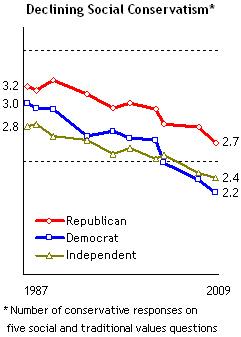
There's a growing chasm between many libertarians and conservatives, but people seem to be tripping over the damned thing without noticing that they've stubbed their toes.

The one thing the libs and cons do seem to agree on is that Sarah Palin was an inspired choice. The staff of one organization told me they pulled down their office Barr memorabilia after she won the nod. Maybe Palin is lying across that chasm all by herself as a human bridge.

Whatever happens with that chasm in the future, I'm finding these meet-and-greets to be worthwhile. The business-card collection is enough justification, as far as I'm concerned. I can't have too many additions to the ... well, nobody uses Rolodexes any more.

Which brings us to the next big boon from this conference. There's a huge emphasis on Web 2.0 and online social networking here -- tutorials and advice that are ideal for anybody who needs to promote a blog or a Website. Yes, I picked up some useful info.

Now, if you'll excuse me, I need to go nail down the left wing of this little gathering by posting another piece or two at Examiner.com calling for legalizing prostitution.

Labels: ,

Friday, July 11, 2008

Bob Barr and libertarians plugged in Time

Advocates of personal freedom and small government are back on the national media's radar -- in a big way. In "The (Not So) Lunatic Fringe," Time magazine recognizes the relevance of the broad libertarian movement to an extent that has been all-too-rare in recent years.

The credit for this coverage belongs to those millions of Americans who care deeply about freedom -- or who just want to be left alone. They might be philosophical libertarians overall, or primarily dope smokers, or civil libertarians, or home-schoolers, or gun owners, or advocates of Internet autonomy, but their passions have come together this year in two important ways that have propelled the libertarian movement onto the national stage: the enthusiastic backing and impressive support Rep. Ron Paul won during his unsuccessful campaign for the Republican presidential nomination, and the popular support Bob Barr is drawing as the Libertarian candidate for president.

Going against its purist tendencies, the Libertarian Party did its best this year to benefit from the enthusiasm Paul generated by nominating conservative-leaning, moderate libertarian Barr. As of this week, Zogby has Barr polling at 6% nationally -- the margin between Republican John McCain and Democrat Barack Obama -- making him impossible to ignore, especially since he draws even more impressive percentages in many states. Yes, the Zogby poll is an outlier, but it's picking up on a real phenomenon -- and probably helping to fuel that phenomenon as it does so.

The current recognition of the relevance of the libertarian movement is almost certainly because libertarianism is being interpreted broadly this year. The hard-line movement that has controlled the political party of the name and largely defined libertarianism in recent years may appeal to my anarchic soul, but it's all too easy to marginalize because it commands relatively few adherents and advocates for positions that are miles away from the world in which we live. When we define advocacy for freedom as 100% rejection of the modern, authoritarian state, we play into the control-freaks' hands, because then they can claim that very few people really want to run their own lives.

But the 85-percenters still want to be a lot freer than modern America allows. Given the realities of the world in which we actually live (rather than the one in which us radicals might like to live), we're all part of the same libertarian movement. That fact is apparent this year for the first time in a long time.

And that's why Time is spilling ink on the subject.

The one nit I'd pick with the Time article is its characterization of libertarianism as backward-looking.

There is a lot in the complaints in the Libertarian heartland that sounds like nostalgia for an idealized American past. Jim Berg will tell you about grazing-rights grievances, but he's just as quick to lament the death of the ranching lifestyle. "My grandkids have scattered like quail," he says. "They've all gone city."

This sense that progress has gone too far and too fast unites a large swath of Libertarians from coast to coast. ...

But the piece then backs away from that seeming-nostalgia-trip take on people who care about freedom, acknowledging that "it's always been partially left-wing, drawing from a long history of American anarchism. The modern challenge is to unite those two wings--or, as magician (and stalwart Libertarian) Penn Jillette told me, 'Convince the dope guys that the gun guys are O.K., and vice versa.'"

There are certainly people in the libertarian movement driven by a hankering for the past, but I think most modern libertarians -- especially younger ones -- look to the future and want to be free to greet it and shape it on their own terms, not those set by fearful, foot-dragging government officials.

But we embrace the nostalgia-trippers too, because finally, this year, many more people who want to live in a more-free, less-constrained country are emphasizing their similarities rather than their differences.

And they're making a difference by doing so.

Labels: , , ,